
You have probably listened to hundreds of hours of podcasts in the last year. You probably can't recall more than a handful of specific ideas from them.
That's not a you problem. That's a tools problem. The podcast app sitting on your phone was designed to help you play audio — not to help you learn from it. And that distinction turns out to matter enormously.
What a Podcast App for Learning Actually Needs to Do
Most podcast apps measure success by one thing: time spent listening. They optimise for streams, downloads, and subscriptions. Your retention is not their metric.
This isn't cynical. It's just what they were built for. The category of "podcast player" was invented to distribute audio files. The playback features exist to serve that. Variable speed, chapter skipping, offline downloads — these are all delivery tools.
But learning is not delivery. Learning is what happens after delivery. And almost no podcast app touches that part.
Here's what the neuroscience says a real podcast app for learning would need to do:
1. Create retrieval opportunities. The testing effect — first documented by E.L. Thorndike in 1909 and extensively studied since by researchers like Henry Roediger and Jeffrey Karpicke — shows that being tested on material dramatically outperforms re-listening or re-reading it. A 2011 study by Karpicke and Janell Blunt found that students who practiced retrieval retained 50% more one week later than students who simply reviewed notes.
A passive podcast player never creates a retrieval opportunity. You listen, you enjoy, you move on. The information starts fading within hours.
2. Space the review. Hermann Ebbinghaus mapped the forgetting curve in the 1880s: without reinforcement, we forget roughly 70% of new information within 24 hours and up to 90% within a week. Spaced repetition — reviewing material at increasing intervals — is the evidence-based antidote. It's why flashcard apps like Anki have dedicated followings among medical students and language learners.
But standard podcast apps have no concept of "review." There is no mechanism to revisit a key idea three days after you heard it, then again in a week. The episode sits in your feed, marked as played, never surfaced again.
3. Make the content searchable and reusable. Audio is ephemeral. Unless something was transcribed, it effectively doesn't exist as knowledge — you can't search it, quote it, link to it, or build on it. Podcast listeners have no way to find the specific moment a host explained that concept they half-remember. They can only scrub through manually, if they bother at all.
The Real Problem: Passive Listening Is the Default
Consider what happens when you listen to a podcast the normal way. You're usually doing something else — commuting, cooking, running. Your attention drifts in and out. You catch the interesting parts. Your brain, primed to conserve energy, classifies the experience as entertainment rather than study and doesn't bother encoding it deeply.
This is the default mode network at work. When we're not actively engaged, the brain's attention systems loosen, and material passes through working memory without reaching long-term storage. You can listen to an entire episode on a topic you care about and, days later, find almost no trace of it.
Standard podcast apps are built for this default mode. They're comfortable with passive listening because passive listening means more listening time, more plays, more numbers that look good on a dashboard.
Luna is built for something different.
What Luna Does Differently
Luna starts from a different premise: that you're listening because you want to actually know something.
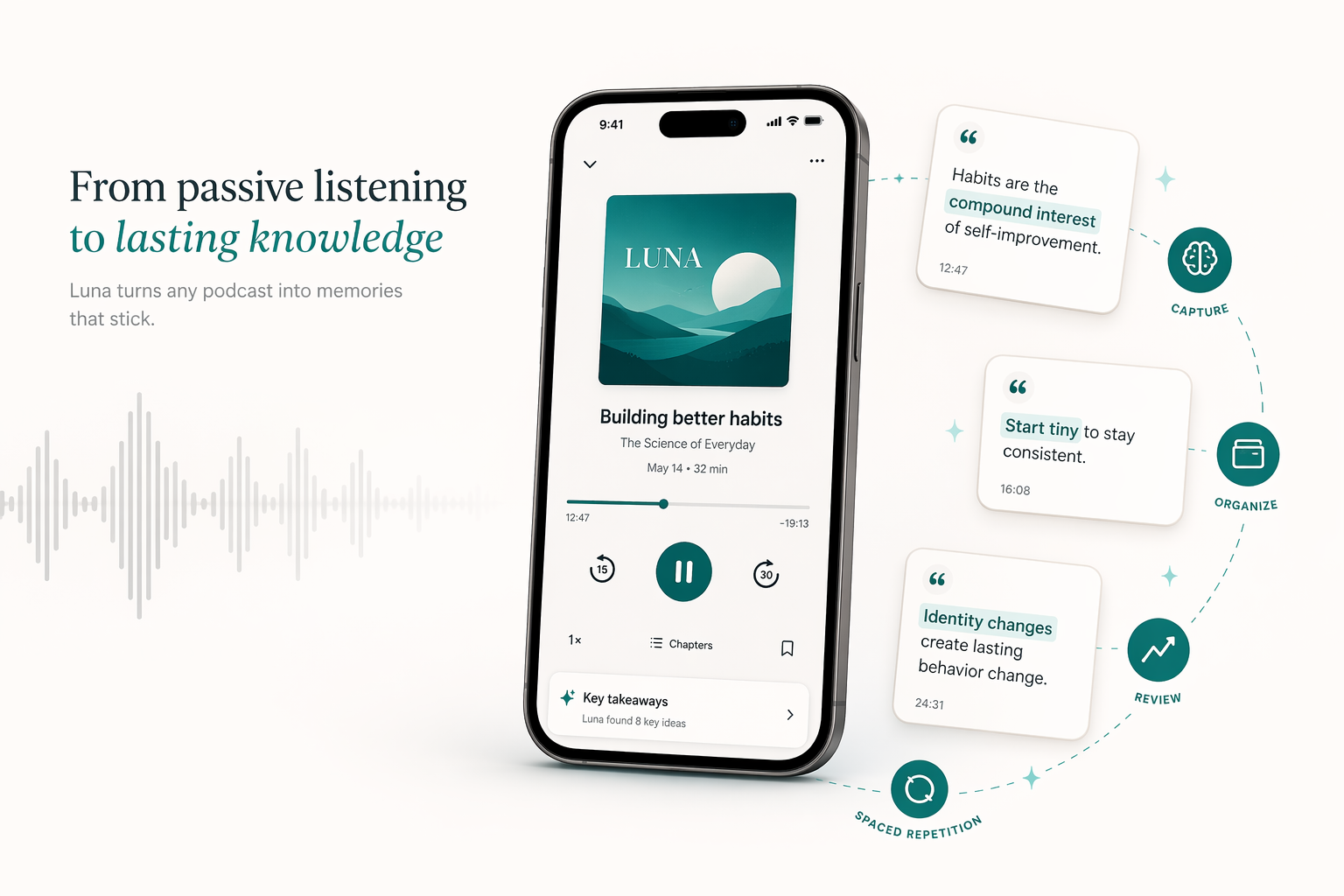
When you save a highlight in Luna, you're not just bookmarking a moment — you're flagging material for review. Luna's AI transcribes the episode automatically, turning that 45-minute conversation into searchable text. Every highlight becomes a retrievable clip with its timestamp intact.
Then Luna schedules those highlights for spaced repetition review. The algorithm surfaces what you need to revisit at the moment your brain is about to forget it — not three weeks later when it's already gone, and not the next morning when it's still fresh. The timing is the point.
Luna also adds a social layer that standard apps lack entirely. Other listeners' timestamped comments sit alongside the transcript, so you can see what a community of active learners found meaningful in the same episode. Shared annotations aren't just social — they're attention cues. Seeing what other people highlighted makes you engage more deliberately with the material yourself.
This is a fundamentally different theory of what a podcast app should do. It's not content delivery. It's a learning environment built around audio.
Why This Matters Now
Educational podcast listening has grown significantly in the last decade. Platforms like Spotify and Apple Podcasts now host tens of thousands of shows that are explicitly positioned as learning tools — science explainers, business breakdowns, language instruction, history deep dives. A study by Edison Research found that 74% of podcast listeners tune in to learn new things.
But the infrastructure for learning hasn't kept pace with the content. The players haven't changed. The format hasn't evolved. You have more high-quality educational audio available than at any point in human history, and the primary tool for consuming it is essentially unchanged from 2005.
The gap between "I heard a lot of interesting podcasts" and "I actually know more than I did six months ago" is not a motivation gap. It's a tooling gap. And it's entirely solvable.
Luna exists to close it. If you want to try a podcast app for learning that actually treats learning as the goal, start with lunacast.ai.
Key Takeaways
- Standard podcast apps optimise for listening time, not learning — they have no retrieval or review features built in
- The testing effect shows retrieval practice improves retention by up to 50% compared to passive re-exposure
- The forgetting curve means 70–90% of audio content is forgotten within a week without reinforcement
- A podcast app for learning needs: AI transcription, highlight capture, spaced repetition review, and retrieval practice
- Luna is built around these mechanisms — turning passive listening into an active, memory-efficient practice
FAQ

About the author
Luna Team
Editorial · Luna